


Syllabus: GS3/ Economy
Context
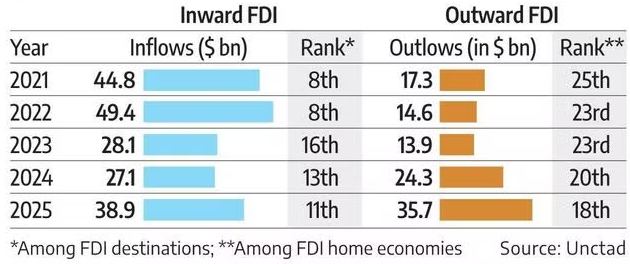
- According to the United Nations Conference on Trade and Development (UNCTAD) World Investment Report 2026, India has moved up two places to become the 11th-largest recipient of Foreign Direct Investment (FDI) globally, with inflows rising significantly in 2025.
India’s FDI Performance
- India attracted $38.89 billion in FDI inflows in 2025, registering a 44% increase compared to $27.09 billion in 2024.
- Greenfield Investments in India: The value of announced greenfield investments fell to $74.12 billion in 2025 from $111.14 billion in 2024.
- However India attracted the world’s largest announced greenfield investment project in 2025. US-based Alphabet Inc announced a $14.5 billion investment in a data centre in India, topping the global list.
India’s Outward FDI
- India’s outward FDI increased by 47%, rising from $24.26 billion in 2024 to $35.66 billion in 2025.
- India improved its position as a major investing economy, ranking 18th globally among FDI source countries.
- Announced overseas greenfield projects by Indian companies rose 41% to $25.29 billion.
- Rana Group announced a $10 billion automotive manufacturing facility in the UAE, among the world’s top five greenfield project announcements.
International Investment Trends
- Global FDI flows remained uneven due to geopolitical tensions, supply chain disruptions and weak investment sentiment.
- Developing economies witnessed only a 2% rise in FDI inflows.
- Developing Asia recorded a modest 3% increase.
- Major FDI destinations:
- The United States remained the largest recipient with $277 billion inflows, despite a 2% decline.
- China retained the 4th position with $104.66 billion, though inflows declined from $116.24 billion in 2024.
What is Foreign Direct Investment (FDI)?
- It refers to investments made by foreign entities (individuals or companies) in the business interests of another country, typically in the form of ownership or control of enterprises.
- At present, FDI is prohibited in lottery, gambling and betting, chit funds, Nidhi company, real estate business, and manufacturing of cigars, cheroots, cigarillos and cigarettes using tobacco.
- Net FDI: It represents the difference between foreign investment entering the country and capital flowing out through disinvestment and repatriation.
- A decline in net FDI does not necessarily imply a fall in investor interest, as gross inflows may remain strong.
Routes for FDI in India
- Automatic Route: It means the entry route through which investment does not require the prior approval of the Reserve Bank of India or the Central Government.
- Most sectors, such as manufacturing and software, fall under this route.
- Government Approval Route: It means the entry route through which investment requires prior Government approval and foreign investment received under this route shall be in accordance with the conditions stipulated by the Government in its approval.
- Sectors such as telecom, media, pharmaceuticals, and insurance fall under this route.
Sectors/Activities in Which FDI is Prohibited
- Lottery Business including Government/private lottery, online lotteries, etc.
- Gambling and Betting including casinos etc.
- Chit funds, Nidhi company, Trading in Transferable Development Rights (TDRs).
- Real Estate Business or Construction of Farm Houses;
- ‘Real estate business’ shall not include development of townships, construction of residential /commercial premises, roads or bridges and Real Estate Investment Trusts (REITs) registered and regulated under the SEBI (REITs) Regulations 2014.
- Manufacturing of cigars, cheroots, cigarillos and cigarettes, of tobacco or of tobacco substitutes.
Source: BS
